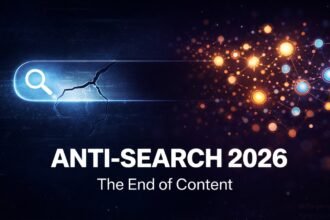



In 2026, Privacy as Luxury is no longer a rhetorical phrase or a niche concern of technologists—it has become a visible social marker. In a world where digital exhaust defines identity, behavior, and economic value, the ability to remain partially unseen has evolved into a powerful signal of autonomy, wealth, and structural advantage. The shift toward “analog living” is not nostalgic regression; it is a calculated response to an environment of total algorithmic exposure.
This transformation marks a deeper realignment in how status is constructed in the digital age. For most of the last two decades, visibility equaled relevance. Now, controlled invisibility is emerging as the more valuable asset.
This shift toward Privacy as Luxury reflects a deeper change in how power, autonomy, and status are structured in the digital age.
From Connectivity to Saturation: How Privacy as Luxury Emerged
The early internet promised empowerment through access. Social platforms rewarded participation, constant presence, and data sharing. Over time, however, participation became compulsory rather than optional. By the mid-2020s, predictive systems had advanced to the point where individuals were no longer merely users of platforms—they were fully indexed entities within them.
This saturation has produced what many analysts describe as data fatigue. Personal behavior, preferences, location history, biometric signals, and social graphs are now persistently logged, inferred, and monetized. The result is a cultural reversal: what was once framed as frictionless convenience is increasingly perceived as surveillance by default.
In this environment, privacy is no longer evenly distributed. It is stratified.
The New Divide: Connected Class vs. Analog Elite
A defining feature of the Analog 2026 shift is the emergence of a clear social bifurcation. On one side is the Connected Class—individuals whose work, communication, and identity remain deeply embedded within ad-supported, AI-mediated systems. On the other is a smaller but growing Analog Elite, for whom digital presence is minimized, curated, or deliberately fragmented.
This divide is not about technological illiteracy. In fact, the Analog Elite are often the most technologically fluent. Their withdrawal is strategic, not accidental. They understand how systems extract value, and they can afford to opt out of constant participation.
Being permanently reachable, once a marker of importance, now signals dependency. In contrast, limited accessibility implies leverage.
The Economics of Invisibility
At its core, Privacy as Luxury follows a classic economic logic: scarcity drives value. As total surveillance becomes the norm, the untracked individual becomes anomalous—and therefore powerful.
This logic is manifesting physically as well as digitally. High-end real estate developments increasingly market signal isolation as a feature, not a flaw. Faraday-shielded architecture, restricted connectivity zones, and device-free environments are becoming status amenities. These are not anti-technology spaces; they are post-surveillance spaces.
A parallel service economy has also emerged. Specialists in digital footprint reduction, identity compartmentalization, and long-term data hygiene—sometimes referred to as “privacy architects”—are in growing demand. Their role is not to eliminate data entirely, but to control its exposure and context.
In this sense, data has become analogous to natural resources. Those who can afford to leave it unextracted retain strategic independence.
Cultural Reorientation: The Decline of Performative Visibility
Culturally, the shift away from hyper-visibility represents a decisive break from the performative logic of the 2010s. That era prized documentation: experiences mattered insofar as they could be shared, validated, and optimized for engagement.
In 2026, prestige increasingly attaches to the unrecorded experience. Private gatherings, device-free travel, and offline rituals are framed as rare and valuable precisely because they leave no trace. Among younger demographics in particular, intentional absence from social platforms is being reinterpreted as discipline rather than disengagement.
This does not imply a wholesale rejection of digital tools. Instead, it reflects a recalibration of boundaries. The question is no longer how visible one can be, but how selectively one appears.
Implications for Power, Work, and Identity
The implications of this shift extend beyond lifestyle. In professional contexts, constant availability is being reassessed. High-status individuals increasingly delegate communication layers, creating buffers between themselves and real-time demands. In effect, privacy becomes a form of temporal control.
At the identity level, algorithmic profiling has reduced individuals to predictable patterns. The Analog 2026 movement can be read as resistance to that flattening. By limiting data inputs, individuals reintroduce uncertainty—an element that machines struggle to model and institutions cannot easily appropriate.
Importantly, this trend does not suggest that privacy is universally attainable. Structural inequalities remain. For most people, opting out carries real economic and social costs. This asymmetry reinforces the notion that privacy is no longer a baseline right but a differentiated asset.
What Changes Next
Looking ahead, the trajectory suggests that privacy will continue to migrate upward as a status marker. As AI systems become more deeply embedded in governance, commerce, and daily life, the ability to step outside those systems—even temporarily—will confer increasing symbolic and practical power.
This also raises critical questions about consent, autonomy, and democratic access in a post-opt-out world. If privacy is only available to those who can afford it, the long-term consequences for social trust and institutional legitimacy remain unresolved.
Conclusion
The rise of Privacy as Luxury reflects a fundamental inversion of digital values. Visibility, once equated with opportunity, is now increasingly associated with exposure and constraint. In response, a new elite is redefining status not through amplification, but through absence.
What we are witnessing is not a trend, but the institutionalization of Privacy as Luxury.
As the digital environment of 2026 continues to harden around extraction and prediction, the most meaningful assertion of agency may lie in what is deliberately withheld. In the spaces between data points, a new form of power is quietly taking shape.