

Building a Second Brain 2026 is no longer a productivity hack—it is a structural response to digital overload. Your brain is for having ideas, not holding them. Yet in 2026, most people are attempting to use a biological organ as if it were cloud storage.
- What Is Building a Second Brain 2026?
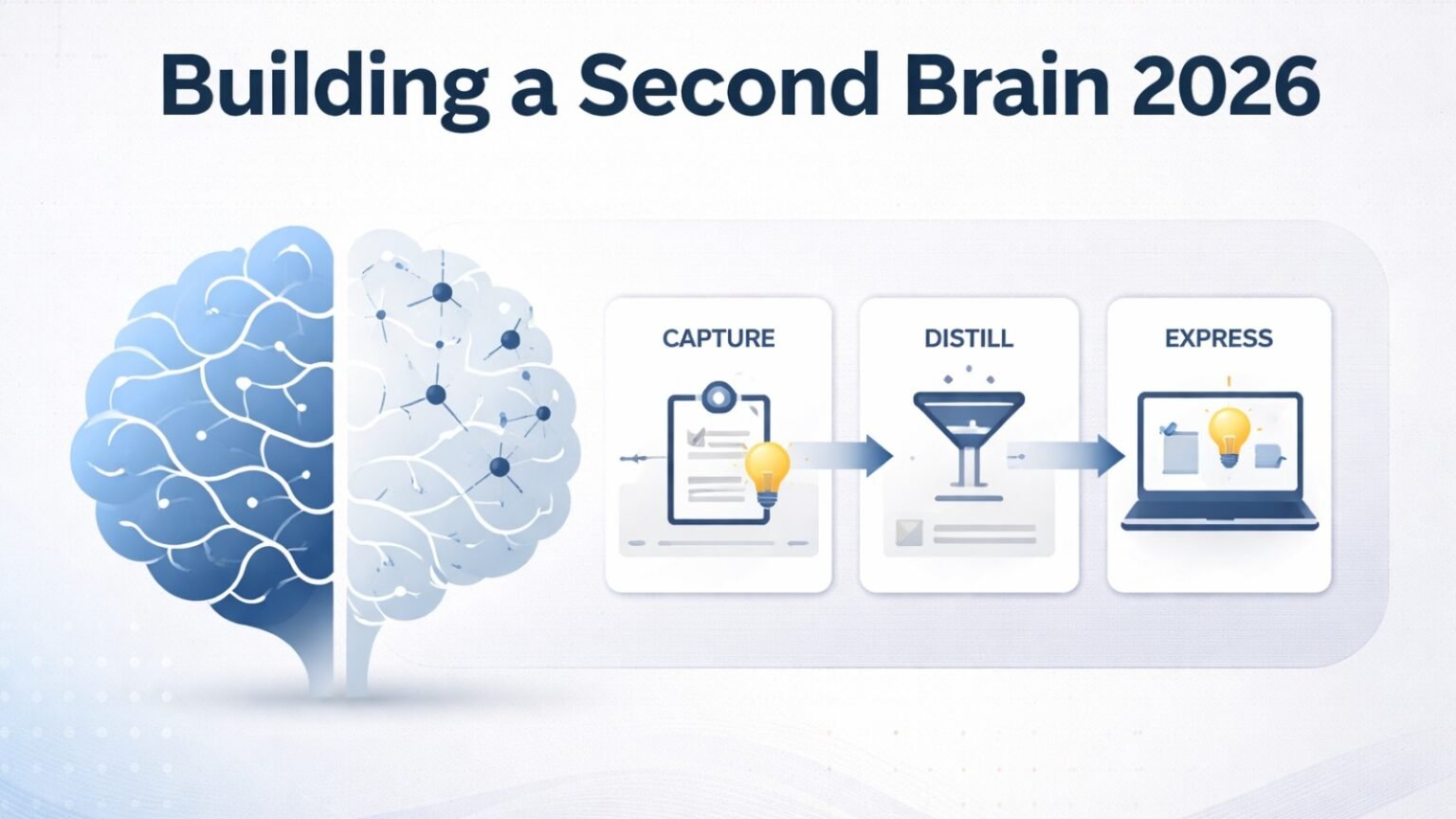
- The System Blueprint: Capture → Distill → Express
- Phase 1: Capture (The 1-Second Rule)
- Phase 2: Distill (Extract the Signal)
- Phase 3: Express (Activate the System)
- Mental Hygiene in the AI Era
- Behavioral Logic: Why This Prevents Burnout
- Strategic Implications for 2026
- Conclusion
- Why This Matters
The modern world was engineered to exhaust you. Slack notifications, endless email threads, short-form video loops, AI alerts, breaking news cycles—each fragment competes for attention. Studies estimate the average human now consumes the equivalent of tens of gigabytes of information daily. Your brain was never designed for that.
It evolved for pattern recognition, emotional calibration, and decision-making—not archiving infinite inputs.
When you try to remember everything, you do not become more productive. You become anxious. The solution is not “focus harder.” The solution is architectural: offload memory to a system.
What Is Building a Second Brain 2026?
Building a Second Brain 2026 means constructing an external, structured system that stores ideas, tasks, research, and insights outside your biological memory.
It is not simply note-taking. It is not hoarding PDFs. It is not bookmarking 100 tabs “for later.”
It is building a Personal Knowledge Graph—an ecosystem where information connects, evolves, and becomes useful at the moment you need it.
In practice, this means:
- Capturing ideas instantly
- Distilling information into usable insight
- Reviewing and expressing what matters
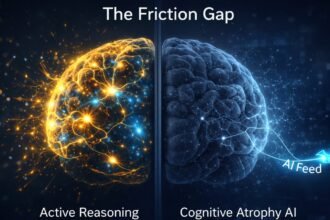
A Second Brain reduces cognitive load — a principle we also explored in Hidden Cognitive Atrophy AI Crisis: The Use-It-or-Lose-It Risk, where we examine what happens when thinking is outsourced without structure.
The System Blueprint: Capture → Distill → Express
Building a Second Brain 2026 fails when people overcomplicate it. The system must be frictionless. If it is heavy, you will abandon it.
Here is the framework we apply at Acutance Intel to manage our research layer.
Phase 1: Capture (The 1-Second Rule)
If capturing an idea takes longer than one second, you will not do it consistently.
The rule is simple:
Do not memorize it. Capture it.
When an insight appears—during a podcast, while reading, during a meeting—you immediately store it in a frictionless inbox.
The tool matters less than the principle. The capture layer must:
- Work across devices
- Be instant
- Require zero formatting
This eliminates the silent anxiety of “I must remember this.”
Instead of holding the thought, you release it.
Phase 2: Distill (Extract the Signal)
Most people store entire articles. That is noise accumulation.
Building a Second Brain 2026 requires distillation. You save the insight, not the information.
For example:
Instead of saving a 2,000-word essay, extract the 3 atomic concepts that matter.
AI dramatically accelerates this layer. You can feed a long article into a summarization model and request structured insights. But the system still requires human judgment.
The principle is critical:
Store conclusions, not clutter.
This prevents your Second Brain from becoming a digital landfill.
Phase 3: Express (Activate the System)
A Second Brain that is never reviewed becomes a graveyard of forgotten ideas.
Every week, review your capture inbox. Ask:
- What connects to my current work?
- What deserves development?
- What should be deleted?
Expression transforms storage into output.
You write.
You create.
You build.
The system exists to serve production—not passive accumulation.
Cognitive psychology research shows that reducing working memory load improves performance, decision quality, and emotional regulation — reinforcing why structured external systems enhance cognitive efficiency.
Mental Hygiene in the AI Era
We treat physical hygiene seriously. We brush teeth. We wash hands.
But mental hygiene? We let algorithms inject thousands of unfiltered fragments into our cognition daily. Then we wonder why we feel scattered.
Building a Second Brain 2026 is an act of psychological discipline. It is a boundary between your mind and the chaos of the internet.
When you build a structured knowledge system:
- Anxiety drops
- Decision fatigue reduces
- Creative clarity increases
This is not about productivity obsession. It is about nervous system stability.
Your mind is a factory, not a warehouse. Warehouses accumulate dust. Factories transform input into value.
Behavioral Logic: Why This Prevents Burnout
Burnout is rarely caused by workload alone. It is caused by unresolved cognitive tension.
Open loops—unfinished tasks, half-remembered ideas, unstructured inputs—consume background mental bandwidth.
When you offload these loops into a trusted system:
- The brain stops rehearsing reminders
- Working memory frees up
- Emotional stress declines
Neuroscience research on cognitive load supports this principle: the brain performs better when memory demands are reduced and structured externally.
Building a Second Brain 2026 formalizes this into habit.
Strategic Implications for 2026
In the AI era, information production is accelerating—not slowing. Tools now generate content at machine scale.
This means the bottleneck is no longer access to information.
The bottleneck is filtration and integration.
Those who build structured personal knowledge systems will:
- Think more clearly
- Create more original work
- Avoid algorithmic overwhelm
Those who do not will drown in inputs.
This is no longer optional for knowledge workers, founders, students, or creators. It is infrastructure.
Conclusion
Building a Second Brain 2026 is not about aesthetic note-taking or digital minimalism trends. It is about designing an environment where your mind can operate at full capacity without being buried under excess data.
The system is simple:
Capture instantly.
Distill intelligently.
Express consistently.
Do this weekly. Refine quarterly.
Over time, your external brain becomes an extension of your thinking—not a substitute for it.
Why This Matters
The digital world will not slow down for you. AI will not produce less content next year. Platforms will not reduce noise voluntarily.
The only variable you control is your system.
Building a Second Brain 2026 is a structural defense against burnout—and a foundation for long-term clarity.
Your attention is valuable.
Choose what you remember.
Design how you think.