

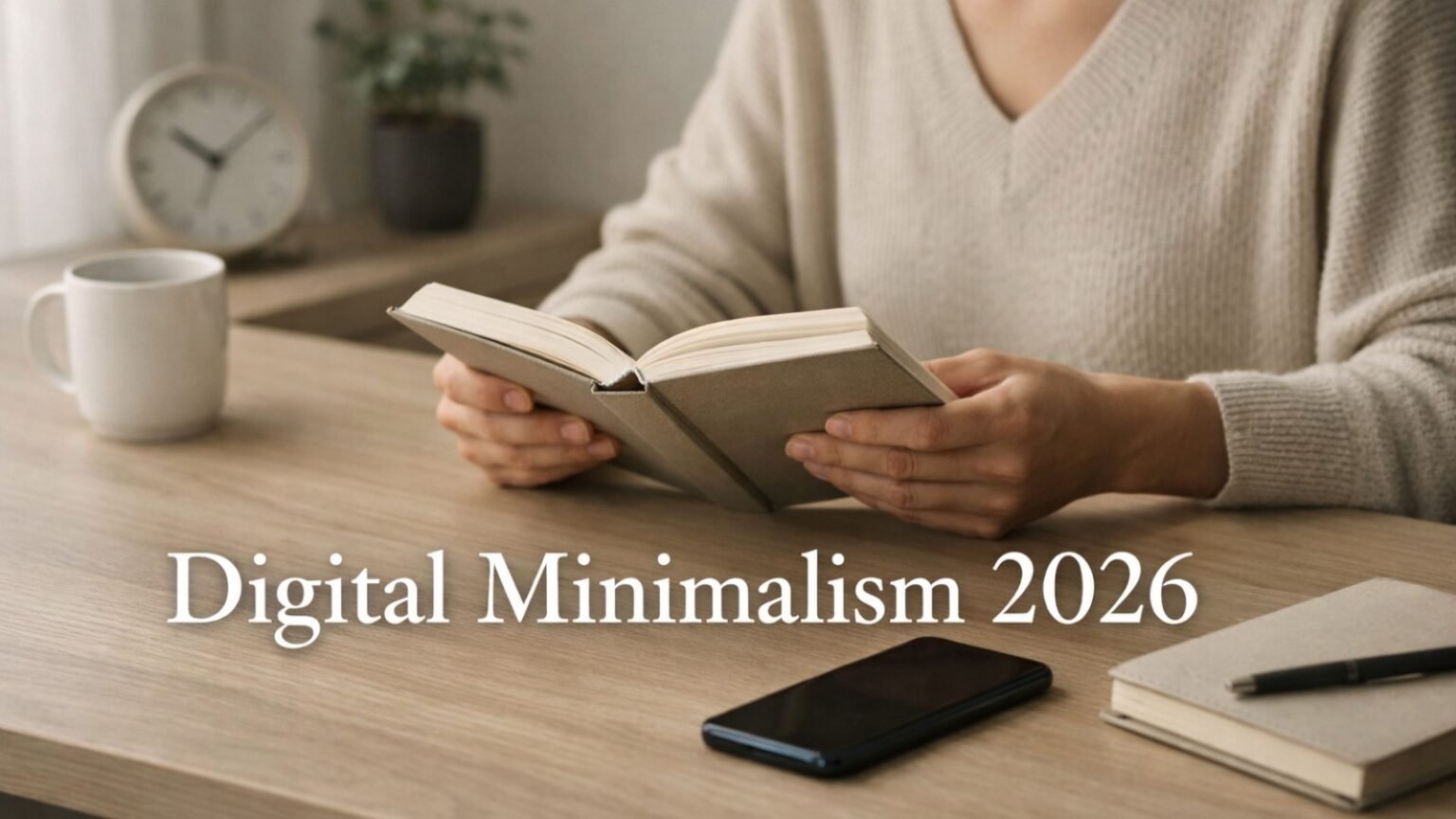

Digital Minimalism 2026 is not about rejecting technology; it is about reclaiming agency in an environment engineered to fragment your attention.
- Digital Minimalism 2026 and the Rise of Distributed Attention
- The “Monk Mode” Morning: Resetting the Dopamine Baseline
- The “Dumb Phone” Partition: Controlled Access, Not Abstinence
- Capture, Don’t Consume: The “Second Brain” Filter
- The Return to Analog: Status Reversal in 2027
- Strategic Implications: Attention as Competitive Advantage
- Conclusion
In 2020, the complaint was “Zoom fatigue.” In 2026, the deeper problem is structural: AI fatigue. Every interface now attempts to anticipate, rewrite, summarize, and stimulate. Notifications are no longer passive alerts; they are predictive engagement triggers. The default mental state of the modern professional has shifted from focus to perpetual scanning.
The issue is not personal weakness. It is environmental design.
Digital Minimalism 2026 and the Rise of Distributed Attention
The defining challenge of Digital Minimalism 2026 is what cognitive scientists increasingly describe as “distributed attention.” Instead of sustained concentration, individuals operate in rapid-switch cycles — messages, feeds, dashboards, summaries, short-form video.
The modern digital stack includes:
- AI-enhanced email rewriting tools
- Auto-generated meeting summaries
- Algorithmically curated news feeds
- Infinite short-form content loops
Each layer reduces friction — but increases stimulus density.
This creates two structural effects:
- Lower Dopamine Baseline: High-frequency micro-rewards reduce motivation for slower, cognitively demanding work.
- Reduced Original Thought Formation: Constant input crowds out boredom, which historically has been a precursor to insight.
The algorithm is not malicious. It is optimized. It is a system trained to maximize engagement signals. Expecting willpower to defeat optimization at scale is unrealistic.
Digital Minimalism 2026 requires systems, not intentions.
The “Monk Mode” Morning: Resetting the Dopamine Baseline
The first hour of your day defines your neurological tone.
When the morning begins with scrolling, reactive messaging, or algorithmic feeds, the brain establishes a consumption-first state. That baseline makes deep work cognitively harder.
The Protocol:
- No screens for the first 60 minutes.
- No email.
- No social feeds.
- No AI summarization tools.
Instead:
- Journaling
- Reading a physical book
- Light movement
- Quiet planning
The objective is not asceticism. It is calibration.
When the brain produces its own dopamine through planning, reflection, or small wins, cognitive resilience improves. This hour becomes a structural anchor for the rest of the day.
Digital Minimalism 2026 treats mornings as neurological infrastructure.
The “Dumb Phone” Partition: Controlled Access, Not Abstinence
The idea of abandoning smartphones entirely is neither realistic nor necessary. Modern life requires:
- Two-factor authentication
- Navigation systems
- Transportation apps
- Financial alerts
Digital Minimalism 2026 introduces partitioning instead of elimination.
Two approaches:
Hardware Partition:
Use a secondary minimal device after a certain hour (e.g., post-8:00 PM) that allows only calls and texts.
Software Partition:
Use app-locking systems to block feeds, browsers, and short-form video after designated times.
This shifts the phone from an entertainment device to an operational tool.
The critical insight: friction is protective.
Removing infinite access during evening hours improves sleep architecture, reduces anxiety loops, and restores conversational presence.
Capture, Don’t Consume: The “Second Brain” Filter
The anxiety of missing out drives compulsive scanning. The solution is not abstinence — it is deferred engagement.
When encountering interesting material:
- Save to a structured “Read Later” system.
- Close the tab immediately.
- Schedule intentional review blocks.
This prevents the internet from dictating your cognitive agenda.
The larger principle:
You do not need more information. You need more clarity.
Digital Minimalism 2026 reframes knowledge accumulation as a deliberate act rather than a reflexive one.
As argued in The Case for Digital Minimalism, intentional disengagement from algorithm-driven environments restores cognitive autonomy and long-form thinking.
The Return to Analog: Status Reversal in 2027
A subtle cultural shift is emerging.
In prior cycles, visible connectivity signaled relevance. In 2027 and beyond, the emerging status symbol may be controlled unreachability.
Reading physical books.
Having device-free dinners.
Maintaining long-form conversations.
These behaviors increasingly signal discipline and sovereignty over one’s time.
The paradox is strategic:
In a world saturated with AI-generated content, original thinking becomes scarce. And originality requires uninterrupted cognitive space.
Boredom is not inefficiency. It is incubation.
Strategic Implications: Attention as Competitive Advantage
For professionals, founders, and creators, Digital Minimalism 2026 is not lifestyle branding — it is performance architecture.
Sustained focus enables:
- Higher quality strategic thinking
- Clearer writing
- Better risk assessment
- More defensible decisions
In algorithmic environments, those who protect their attention will compound advantages.
This aligns with broader structural realities: search referrals to news have declined significantly, while algorithmic feeds dominate visibility. As distribution becomes automated, cognition must become deliberate.
Conclusion
Digital Minimalism 2026 is not about disconnecting from the world. It is about disconnecting from noise.
Surgical disconnection.
Intentional partitions.
Analog reintegration.
These are not nostalgic gestures — they are strategic systems for the AI age.
Why This Matters (The Bigger Picture)
The internet is no longer a static library. It is an adaptive environment.
When content becomes infinite, attention becomes finite.
When stimulation becomes constant, clarity becomes rare.
Those who design boundaries will design better futures.