
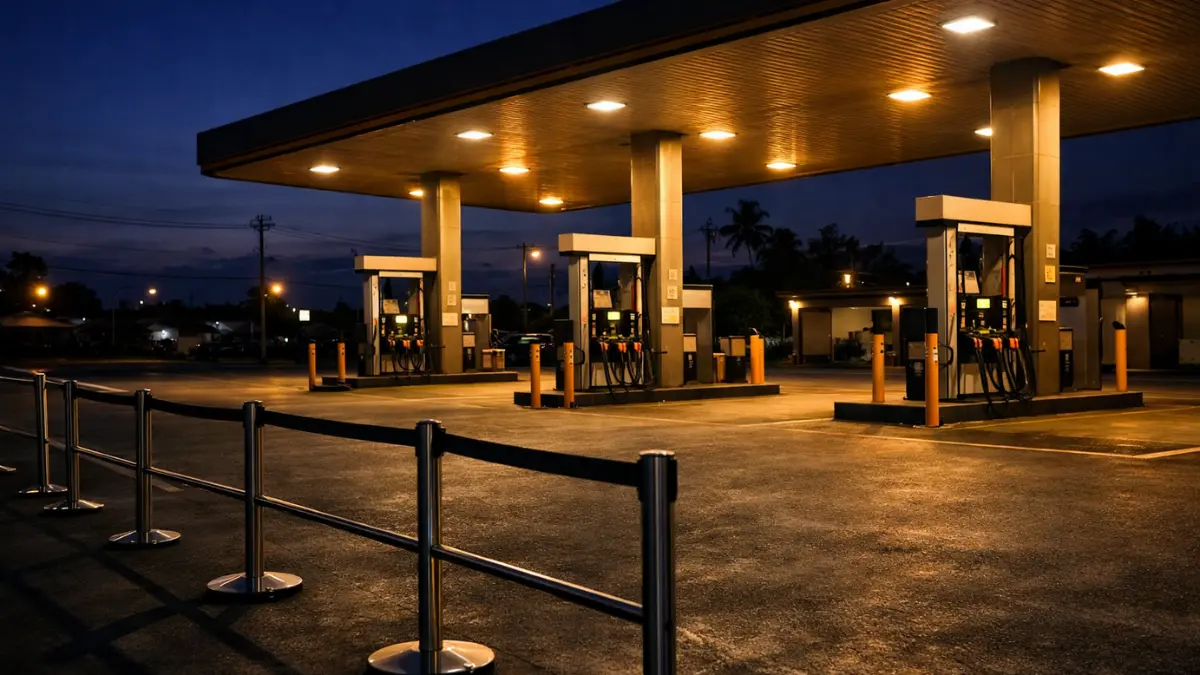

Energy rationing has arrived in Southeast Asia, and its consequences extend well beyond queues at petrol stations. When the Philippines declared a national energy emergency on March 24 — becoming the first country to do so since the Strait of Hormuz closure began — it formally acknowledged what markets had been pricing for weeks: the region’s energy system had not absorbed a price shock. It had fractured. Roughly eighty-four percent of Southeast Asia’s crude oil imports transit Hormuz. Five weeks into the US-Israeli conflict with Iran, that passage remains effectively closed. For an economic bloc built on cheap and accessible fossil fuels, this is not a disruption. It is a structural test the development model was never designed to pass.
The Context
Southeast Asia’s exposure to this crisis accumulated over decades. The Philippines imports close to all of its oil from the Middle East — a dependence reflecting geography, the absence of meaningful domestic reserves, and a policy environment that treated Hormuz transit as permanent infrastructure rather than geopolitical risk. Vietnam, Cambodia, and Laos face comparable vulnerabilities. Even Indonesia and Malaysia — both significant hydrocarbon producers — became net oil importers as domestic demand outpaced extraction over the past decade. President Marcos Jr.’s emergency declaration granted expanded powers to intervene in fuel markets and fast-track procurement from alternative suppliers. The Philippine Senate followed with authority to temporarily suspend excise taxes on petroleum products. These are not routine adjustments. They are the administrative signatures of a system operating outside its design parameters.
Energy Rationing: Southeast Asia’s Governance Response
The immediate governance response across the region is energy rationing through administrative mandate. The Philippines mandated a four-day government workweek, capped office air conditioning, and ordered civil servants to switch off computers during lunch hours. Thailand developed a three-stage fuel contingency plan while diesel prices passed record highs. Vietnam encouraged remote working to cut transport fuel consumption. Laos — carrying heavy debt obligations and near-total import dependency — introduced a three-day school week. Cambodia suspended fuel taxes. Myanmar implemented an odds-and-evens rationing system within days of the conflict’s opening.
The cumulative effect is demand destruction: a managed reduction in economic activity to preserve the fuel supplies that remain. The Hormuz closure assessment confirmed the IEA’s characterisation of this disruption as the largest supply shock in the history of the global oil market, and Southeast Asia — the region most directly exposed to Hormuz flows — is absorbing that shock first. Rationing at this scale is not a short-term fix. It signals that the buffer between policy and economic collapse has narrowed to near-zero in the most import-dependent economies.
The fiscal arithmetic is already breaking down. Thailand’s fuel subsidy programme is costing approximately 1.5 billion baht per day — a figure the government cannot sustain if the disruption extends through the second quarter. Factory output is declining. Airlines are cutting capacity as jet fuel costs double. Agricultural supply chains are fracturing as fishermen remain docked and farmers face fertiliser hoarding driven by natural gas shortfalls.
The Systemic Impact
The geopolitical dimension may prove as consequential as the economic one. The Philippines’ energy emergency has reopened dormant diplomatic conversations. Marcos publicly acknowledged the possibility of a reset with China, citing fresh impetus for stalled talks on joint energy exploration in contested South China Sea areas. Russia has already delivered a tanker carrying over 700,000 barrels. These are not formal strategic pivots — they are the early movements of a regional realignment driven by energy necessity rather than ideology, and each one carries forward costs that will outlast the current conflict.
The IEA’s 2026 energy crisis policy response tracker documents a coordinated emergency architecture spanning more than twenty nations — energy rationing mandates, strategic reserve releases, and alternative procurement mechanisms operating in parallel. The structure of that response resembles wartime resource allocation more than routine market intervention. The governance category has shifted..
Food security adds a further structural layer. Fertilisers produced from natural gas feedstocks are being hoarded or priced beyond reach. Farmers across Thailand, Vietnam, and the Philippines are making planting decisions in conditions of fuel uncertainty — and if that uncertainty extends into the May growing window, agricultural output will carry the consequences forward across seasons. As with critical minerals supply chains, geopolitical shocks upstream are translating into durable downstream disruptions for import-dependent economies long after the original event has passed.
What Changes Next
Three structural shifts are now in motion independent of when Hormuz reopens. Energy security will be institutionalised as a national planning priority: energy rationing across six ASEAN economies within weeks has demonstrated precisely how thin the buffer between policy and collapse had become. Strategic reserve requirements will be legislated, and alternative supplier relationships formalised in ways that carry permanent geopolitical weight. The renewable energy investment case has changed in a single quarter: Spain’s high renewables penetration visibly shielded its electricity prices from the gas surge while Italy’s gas-dependent grid surged in parallel, converting an environmental argument into a national security one before any formal policy decision was required.
The export manufacturing model built on cheap energy as a competitive advantage is under direct pressure. Output reductions in Vietnam, Cambodia, and Thailand — economies embedded in supply chains running into European and North American consumer markets — will prompt supply chain risk managers at global corporations to reassess regional concentration assumptions. That reassessment will not reverse when oil prices stabilise. It will compound.
Conclusion
Southeast Asia’s energy rationing response is a live demonstration of what import dependency costs when global supply chains fail. The administrative measures — four-day workweeks, school closures, air conditioning limits — are symptoms of a structural vulnerability that decades of cheap oil obscured. Whether the Hormuz closure resolves in weeks or extends through summer, the governance decisions being made now will define the region’s energy architecture for the decade ahead.
Why This Matters (The Bigger Picture)
The Philippines’ national energy emergency is not a Southeast Asian story. It is the first visible fracture in a global development model that treated fossil fuel accessibility as a structural given. Every economy that built its industrial base on imported energy is observing this as a stress test it was never designed to pass. The outcomes — diplomatic realignments, strategic reserve legislation, accelerated renewable investment, renegotiated supply contracts — will reshape how this region integrates into global energy, trade, and security systems. The immediate crisis is oil. The structural question is whether development frameworks built on energy dependency can survive a world in which that dependency is deliberately weaponisable.