

The Hormuz ceasefire announced on April 7–8, 2026 has delivered what markets wanted: a sharp fall in oil prices, a relief rally across global equities, and the prospect of tankers moving again through the world’s most critical energy chokepoint. What it has not delivered — and cannot deliver in two weeks — is a structural resolution to the new reality Tehran has engineered over six weeks of conflict.
The Context: What the Hormuz Ceasefire Actually Resolves
Roughly 20% of the world’s oil and natural gas transits the Strait of Hormuz on any given day. That figure has been cited so many times it has lost its weight. To restore it: approximately 21 million barrels of crude and petroleum products per day move through a channel roughly 33 kilometres wide at its narrowest navigable point. There is no alternative route that does not add weeks to transit times and hundreds of millions of dollars in additional shipping costs at scale.
Iran has always known this. What changed in late February 2026 was that Tehran demonstrated — credibly, at global scale, under sustained military pressure — that it could actually close the strait. Not partially. Not symbolically. Effectively. The market had priced that risk theoretically for decades. It has now priced it as a confirmed operational capability. The ceasefire does not erase that demonstration. It codifies it.
Deep Structural Analysis: The Transit Toll Mechanism
The detail that received insufficient attention in the relief rally is the transit fee structure attached to the ceasefire terms. Reports confirmed during the conflict that Tehran was charging shipping companies up to $2 million per vessel for guaranteed safe passage. Iranian Foreign Minister Abbas Araghchi confirmed that transit would be “possible via coordination with Iran’s Armed Forces” — a formulation that institutionalises Iranian military oversight of a supposedly international waterway.
Neil Shearing, group chief economist at Capital Economics, estimated that a $1–2 million per tanker fee translates to roughly $1 per barrel added to the cost of oil transported through the strait. That modest per-barrel figure represents what one analyst described as a “de facto partial nationalisation of the shipping route.” This is not a toll booth. It is a governance claim over infrastructure that the international community has long treated as open waters under the UN Convention on the Law of the Sea.
The structural dynamics of Hormuz as a global energy chokepoint were documented before this ceasefire — what has changed is that Iran has converted theoretical leverage into an institutionalised operating practice. For shipping insurers, the calculus is equally uncomfortable. War risk premiums that spiked during the conflict do not normalise overnight. Tanker owners need explicit operational clarity from Tehran — not a social media post from a US president — before committing vessels and capital to a route that just demonstrated it can be closed at will.
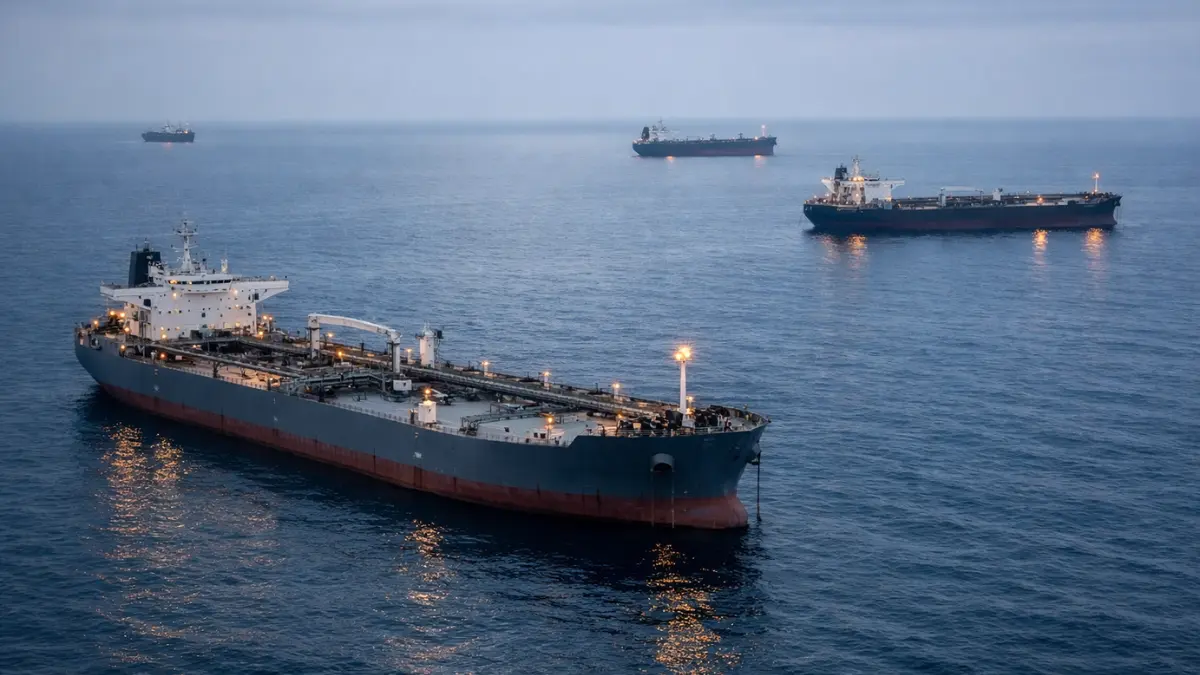
As of April 8, 187 tankers carrying 172 million barrels remained stranded in the Gulf, according to Kpler, a global trade intelligence firm. That backlog will take days to weeks to clear even under the Hormuz ceasefire terms — and only if the strait operates without incident throughout the truce period.
The Systemic Impact: Who Benefits, Who Remains Exposed
The immediate beneficiaries are clear. Airlines, facing potentially catastrophic fuel cost increases, received a significant earnings tailwind the moment Brent dropped below $100. Manufacturers with energy-intensive supply chains, consumer goods companies under input cost pressure, and economies running on imported fuel all gain from lower oil prices — provided the gains hold.
OPEC faces a more complex calculus. Saudi Arabia, the UAE, and other major producers had maintained disciplined output management even as prices surged toward $120 per barrel. With Iranian supply potentially returning to market and prices falling sharply, the cartel must navigate the tension between protecting fiscal breakeven levels — several member states require oil above $80 a barrel to balance national budgets — and avoiding a price war that erodes revenue for all parties.
The economies most exposed remain those that were already rationing before the ceasefire. Southeast Asia’s fuel emergency illustrated precisely how quickly import-dependent economies reach crisis point when Hormuz access is restricted — and the structural vulnerability has not disappeared with a two-week truce. Shipping insurance must be re-established, tanker schedules rebuilt, and port logistics reconfigured. According to RSM US chief economist Joe Brusuelas, that process requires confidence-building measures that accumulate over time, not announcements that arrive on social media.
Analysts at Jefferies noted that while re-escalation remains possible, “uncertainty has likely peaked” — a careful formulation that acknowledges the relief without endorsing the assumption that risk has passed. Brent crude remained near $93–95 per barrel on April 8, well above the $67 level it settled at before the war began in late February.
What Changes Next
The two-week window is a negotiating interval, not a resolution. Iran has entered these talks having demonstrated that it can shut down 20% of global energy supply, having established a transit fee mechanism over an international waterway, and having weathered six weeks of sustained US and Israeli military pressure. That is a considerably stronger negotiating position than Tehran occupied on February 27.
The embedded inflation the Hormuz ceasefire cannot reverse is already filtering through airline fares, food transport costs, and manufacturing input prices across multiple continents.” A ceasefire does not reverse that transmission. Oil prices at $92–97 per barrel remain well above pre-war settlement, and the IMF and World Bank warnings about serious global economic consequences — issued during the conflict — have not been retracted.
For energy markets, the 30–60 day horizon depends almost entirely on whether Iranian transit coordination produces durable, predictable passage — or whether tanker owners continue to seek explicit clearance vessel by vessel. The latter scenario sustains Iran’s de facto toll system regardless of what any eventual peace agreement says. For policymakers in Tokyo, Seoul, Manila, and Brussels, the question is no longer whether Hormuz can be closed. It is how to price that risk permanently into energy security strategy.
Conclusion
The ceasefire has done what ceasefires do: stopped the immediate escalation and returned oil prices toward a level that markets can function with. What it has not done is alter the structural architecture that the conflict revealed. Iran has demonstrated Hormuz closure capability, established a transit coordination mechanism, and entered negotiations from a position of confirmed leverage. Two weeks of reduced hostilities does not undo any of those facts.
The structural story of the Hormuz ceasefire in 2026 is not about whether oil falls below $90 or whether the truce holds for fourteen days. It is about who now effectively governs the world’s most consequential energy corridor — and what the answer to that question costs every importing economy on earth.
Why This Matters (The Bigger Picture)
The Hormuz ceasefire marks the moment the global energy system formally re-priced a risk it had carried theoretically for four decades. Iran’s demonstrated ability to close the strait — and its move to institutionalise transit coordination under military oversight — introduces a permanent structural variable into global energy security planning that no agreement removes. Shipping insurers, OPEC members, Asian import-dependent economies, and Western policymakers are now operating in a post-demonstration environment. The price of oil may recover. The architecture of Hormuz has changed.