

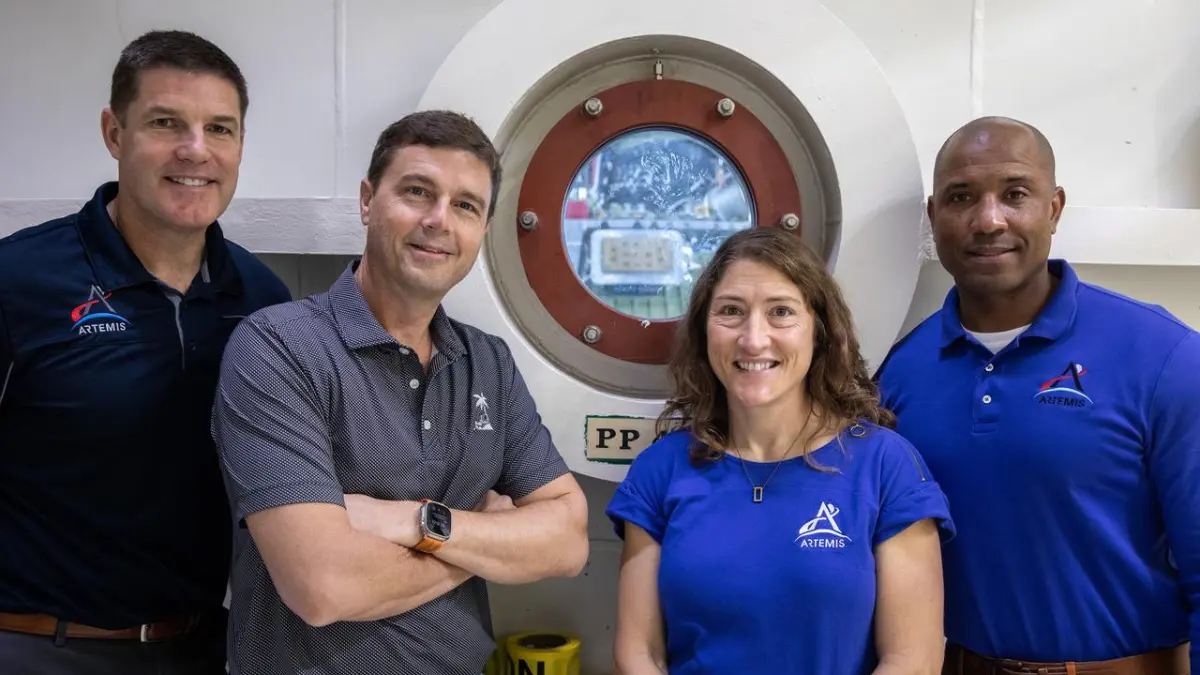

Artemis II splashed down in the Pacific Ocean off San Diego on Friday evening, completing humanity’s first journey to the vicinity of the Moon since Apollo 17 in December 1972 — a gap of 53 years that most people alive today have lived their entire lives inside. Four astronauts, a 10-day mission, and a heat shield with known design flaws. It worked.
The Context: What 53 Years of Absence Means
The Apollo programme ended not because humanity ran out of Moon to explore. It ended because the political and institutional conditions that produced it dissolved. The Vietnam War, Watergate, economic stagflation, and a public that had stopped watching — these were the forces that grounded human spaceflight at the lunar threshold. What followed was four decades of low Earth orbit. The International Space Station was extraordinary in its own right, but it was, structurally, a holding pattern.
The decision to build towards the Moon again — the Artemis programme, authorised under the 2017 NASA Transition Authorization Act and sustained across three administrations — is itself a signal worth reading carefully. It survived budget fights, contractor disputes, COVID delays, and a political climate that agreed on almost nothing else. That kind of institutional persistence is rare. It says something about what a society is willing to underwrite when the argument is framed correctly.
Commander Reid Wiseman, pilot Victor Glover, mission specialist Christina Koch, and Canadian astronaut Jeremy Hansen launched on April 1 aboard NASA’s Orion spacecraft atop the Space Launch System. They swung around the far side of the Moon on April 6 — setting a new record for the farthest distance humans have ever traveled from Earth — and began their return. On Friday, they landed. Mission Control called it “a perfect bullseye splashdown.” NASA Administrator Jared Isaacman confirmed that Artemis III, which aims to actually land on the Moon, is targeting 2027.
What Artemis II Actually Proved
The technical achievements are real, but the cultural significance runs deeper than the engineering. Artemis II confirmed that the infrastructure for deep space human travel — Orion’s life support, SLS’s propulsion, ground control’s deep space communication — functions as designed when human lives depend on it. That is a different category of confirmation than an uncrewed test flight provides.
There is also a geopolitical dimension that has been systematically underplayed in the immediate coverage. China’s space programme is targeting a crewed lunar landing by 2030. The strategic competition between the US and China that is reshaping technology and infrastructure globally extends directly into the lunar domain — who establishes a permanent presence on the Moon first will have a structural advantage in defining the governance frameworks, resource access rules, and communication infrastructure of cislunar space for decades. The mission is not simply a scientific endeavour. It is a staking of claim.
The mission also produced a moment of unusual cultural resonance in an otherwise fractured political environment. Astronaut Jeremy Hansen became the first non-American to join a lunar mission. The crew named a Moon crater “Carroll” after Commander Wiseman’s late wife — a gesture of personal grief turned into permanent cartography. These are not incidental details. They are the texture of an event that crossed political and demographic lines in a way that almost nothing does anymore.
The Systemic Impact: Institutional Trust and What Follows
The deeper structural question raised by Friday’s splashdown is what it signals about the relationship between public institutions and public trust at a moment when that relationship is under sustained pressure. According to NASA’s official mission documentation, the crew conducted a full evaluation of Orion’s systems across the deep space environment — heat management, propulsion, life support, navigation — under conditions that cannot be replicated in any Earth-based test.
What public institutions deliver matters less, in the current cultural climate, than whether they are seen to deliver. Digital trust has been fragmenting steadily — audiences are harder to hold, credibility is harder to sustain, and institutional claims are met with reflexive scepticism. A successful moon mission — with live footage, a recovery crew, four astronauts walking off a ship — is one of the few events that cuts through that ambient distrust. It is verifiable. It is visible. It happened.
NASA’s budget faces a proposed 23% cut in the administration’s 2027 proposal, though the Artemis programme itself received a $731 million increase within that same budget. Congress rejected aggressive science funding cuts last year. The political economy of the programme is not straightforward, but Friday’s splashdown strengthens the argument for continued investment in a way that no budget memo can replicate.
What Changes Next
Artemis III — the Moon landing mission — is now the central focus. A 2027 target is aggressive. The Starship human landing system, built by SpaceX, needs to complete its own qualification testing before it can carry Artemis astronauts to the lunar surface. The Lunar Gateway space station, which was part of the original architecture, was cancelled in March 2026 — a structural simplification that shortens the critical path but removes a redundancy layer.
The broader implication is that the Moon is returning to the centre of strategic geography in a way it has not occupied since 1972. Helium-3 deposits, water ice at the lunar poles, and the communications relay position of cislunar space are all resources and locations that will matter considerably in the 2030s and beyond. Friday’s splashdown did not resolve any of those questions. It confirmed that the human infrastructure to engage with them is functional.
Conclusion
The mission is now in the record books. It accomplished what it set out to do — it put human beings near the Moon and brought them home safely. What it represents, structurally, is a proof of concept for a more ambitious decade of space exploration that begins in 2027. Whether that decade materialises depends on budget continuity, political will, and the performance of systems not yet fully tested. None of that was settled Friday evening. But the question got considerably more serious.
Why This Matters (The Bigger Picture)
Fifty-three years is a long time to be absent from somewhere. The generation that watched Apollo 11 in 1969 was told this was the beginning of something. It was, instead, the end of something — and what followed was a long institutional pause dressed up as progress. Artemis II does not erase that pause, but it closes it. The first humans to travel toward the Moon in over half a century came back safely. That fact now sits in the record permanently, alongside whatever political turbulence surrounds it.
The civilisational argument for deep space exploration has always been the same: that the species which stops pushing at its own limits tends to stop for longer than it planned. Friday’s splashdown is a data point against that tendency. A small one, but a real one.