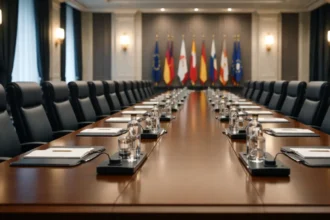



The UK-EU summit announced by Prime Minister Keir Starmer for late June or early July 2026 is the most consequential diplomatic commitment Britain has made since leaving the European Union. Not because of what has been agreed — the specific terms are still being negotiated — but because of what is driving it. The Iran war, the deterioration of the US-UK relationship under sustained Trump pressure, and a domestic economy still carrying the structural weight of Brexit have converged into a single political moment. Starmer is not choosing Europe over America. He is responding to a world in which the assumption of reliable American partnership has become structurally untenable.
That is a different kind of foreign policy pivot. And it has different staying power.
What the UK EU Summit Actually Represents
Every previous Brexit reset attempt operated within a comfort zone: closer cooperation in specific areas — agriculture, energy, youth mobility — while preserving the formal distance that Leave voters demanded and the government’s internal politics required. The May 2025 summit produced frameworks. It ratified existing commitments. It was, in Starmer’s own framing for the upcoming meeting, a “stocktake.”
The 2026 summit is explicitly designed to go further. Starmer described it as pursuing “closer economic cooperation, closer security cooperation” — language that goes beyond the incremental framing of previous engagements. He acknowledged Brexit had caused “deep damage” to the UK economy, citing Stanford University research estimating a 6–8% GDP reduction attributable to the withdrawal process. These are not the talking points of a government managing optics. They are the language of a government that has reassessed its strategic position.
Starmer stated explicitly that the upcoming summit would not simply ratify previous commitments — it would pursue genuinely new ground in both economic and security domains. The centrepiece, as currently framed, is a partnership built on shared values and shared strategic interest in a world that both the UK and the EU are navigating without reliable American leadership.
Deep Structural Analysis: Why the Iran War Changed the Calculation
The immediate trigger is the US-Israeli military engagement with Iran, which began fracturing the transatlantic alliance in ways that Brexit never fully did. Trump publicly criticised Starmer for initially refusing to allow US planes to use UK bases for pre-emptive strikes — calling him “not Winston Churchill” and threatening to pull the US from NATO, describing the alliance as a “paper tiger.” These are not diplomatic friction points. They are signals of structural US disengagement from the burden-sharing model that has underwritten European security since 1945.
The democratic stress fractures already visible across European political systems have been compounding this pressure from the inside. A Europe navigating illiberal drift in its eastern members while simultaneously losing confidence in US security guarantees is a Europe that needs Britain more than it did in 2020. And Britain — facing energy price shocks, a stagnant economy, and an American president who has made the special relationship conditional on military alignment — needs Europe more than it has acknowledged in the years since the referendum.
The Iran war has made this mutual need visible and politically expressible in a way that previous economic arguments could not achieve. Starmer’s April 1 announcement drew on this moment explicitly — framing the EU summit not as an ideological reversal but as a pragmatic response to a world that has changed faster than Britain’s foreign policy doctrine.
The Systemic Impact: What Closer Cooperation Actually Requires
The rhetoric of UK-EU rapprochement is easier than its architecture. Three structural constraints define what the summer summit can realistically deliver.
First, trade and regulatory alignment. Closer economic cooperation almost certainly requires movement toward EU single market rules in specific sectors — particularly food standards, financial services, and energy. Each area carries domestic political cost. The Conservatives and Reform UK have already framed any concession as a betrayal of Brexit. Starmer’s room to manoeuvre is real but bounded.
Second, defence and security integration. The UK’s participation in EU defence procurement and joint capability development is the area where mutual interest is clearest and political resistance is lowest. Post-Brexit, the UK has been largely excluded from EU defence cooperation frameworks. A security partnership agreement that restores meaningful joint capability development would have concrete strategic value — and would directly address Trump’s demand that European nations do more for their own defence.
Third, the Irish question and Northern Ireland. Any deepening of UK-EU economic alignment reopens questions about the Northern Ireland Protocol and its successor, the Windsor Framework. The political geography of that issue has not changed. Progress in the economic relationship will require sustained management of an inherently fragile settlement.
The broader pattern of US allies reassessing their strategic dependencies is not unique to Britain. The Taiwan Strait realignment, the South Korean shipbuilding deal, and now the UK’s European pivot all reflect a common underlying adjustment: governments that built their security architecture on the assumption of consistent American engagement are now designing hedges against its absence.
What Changes Next
The summit’s success will be measured not by the communiqué language but by whether it produces enforceable frameworks in at least one substantive area — most likely defence procurement or energy market access. A summit that produces only aspirational language will be read as another stocktake, regardless of Starmer’s framing.
The domestic political context matters. Labour has fallen to fourth place in some UK national polling. A summit that produces tangible cost-of-living benefits — lower energy costs through better EU market integration, reduced trade friction — would serve the government’s electoral interests as well as its strategic ones. The alignment of strategic and political incentives makes this reset more durable than its predecessors.
The EU’s posture matters equally. Brussels has welcomed Starmer’s mood shift but has not made UK-EU rapprochement a strategic priority. The bloc is managing its own internal pressures. Whether the EU is prepared to offer Britain genuinely new access — beyond the existing frameworks — will determine the summit’s substantive output as much as anything Starmer does.
Conclusion
Britain’s pivot toward Europe in 2026 is structurally distinct from every previous reset attempt because its driver is not a political preference — it is a geopolitical necessity produced by a fracturing US alliance, an energy shock with no near-term resolution, and a domestic economy that cannot afford to maintain the fiction that Brexit’s costs are manageable without structural remedy. Starmer is not reversing Brexit. He is engineering the closest relationship possible within the political constraints that remain. Whether that is enough depends on how much the world outside those constraints continues to change.
Why This Matters (The Bigger Picture)
The UK-EU summit of summer 2026 will not be remembered as the moment Britain rejoined the European Union. It may be remembered as the moment Britain stopped pretending that it could afford the strategic isolation that Brexit produced. The Iran war did not create the structural case for closer UK-EU cooperation — that case was always there, in the trade data and the energy dependencies and the security architecture. What the war did was remove the political cover for ignoring it. That is a different kind of inflection point. It tends to be more durable.