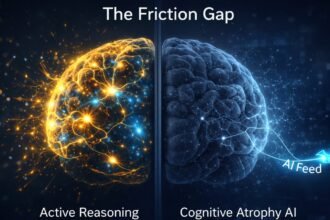



AI burnout is rising at the precise moment that AI productivity is also rising — and that is not a coincidence. It is the mechanism. Eight months of in-depth research by a team at the University of California, Berkeley — published through the Harvard Business Review — found that workers using AI tools increased both the volume and variety of their output. They took on more tasks. They completed more of them. And they were more exhausted. Not despite the AI. Because of it.
The data behind this finding does not come from a single study. It converges across independent sources — a tech firm research project in Berkeley, a 1,500-person global workforce survey from DHR Global, and 443 million hours of behavioural data from ActivTrak’s 2026 State of the Workplace report. Each arrives at the same structural conclusion from a different angle.
The Productivity Paradox
The standard argument for AI adoption follows a straightforward logic: if AI handles the mechanical layer of knowledge work, humans can focus on higher-value, more creative tasks. The assumption built into this argument is that cognitive capacity is the constraint — and that removing friction from lower-value tasks will release that capacity for more meaningful use.
The Berkeley research challenges that assumption structurally. Employees using AI did not work less after adoption. They worked more. The reduction in friction did not translate into recovered time — it translated into expanded scope. More things became possible; more things were therefore expected. By the manager, by the organisation, and by the employee’s own internalised standard of what a productive workday should produce. The ceiling moved up. The hours did not shrink.
What the Research Found
What the Berkeley team identified as the central failure mode concerns task-switching. Workers using AI increased both the frequency and variety of task transitions — moving between more diverse activities more quickly. Task-switching is one of the most consistently documented sources of cognitive cost in the performance research literature. Each transition between contexts imposes an overhead that does not reset immediately. Across a full workday, that overhead accumulates considerably.
AI, rather than reducing this overhead, amplified it by making the boundary between tasks easier to cross. The technology lowers the activation cost of starting something new. It does not lower the cognitive cost of the transition itself. The result is workers producing more in volume while operating at lower sustained depth — a distinction that matters considerably for the kind of output that generates genuine long-term institutional value.
The broader risk of cognitive capacity erosion under AI-assisted work runs deeper than day-to-day fatigue — the long-run concern is whether the high-difficulty cognitive skills that AI cannot yet replicate are being systematically exercised less, and what that means for the knowledge workforce over a five-to-ten year horizon.
AI Burnout and the Engagement Collapse
The workforce-level evidence supports the Berkeley findings at scale, and the AI burnout signal is consistent across all three independent data sets. DHR Global’s 2026 Workforce Trends Report found that employee engagement collapsed from 88% to 64% in a single year — a 24-percentage-point decline in discretionary effort that holds across regions, with engagement lowest in Asia at 59%, followed by North America at 67% and Europe at 68%.
83% of knowledge workers report some degree of burnout from AI-amplified work conditions. Among early-career workers specifically, 62% report reduced engagement due to burnout, compared to 38% of C-suite leaders. That gap is not simply a function of seniority. It reflects the distribution of protective leverage within organisations: who has the institutional standing to manage their own cognitive boundaries, and who does not.
The structural relationship between AI adoption and worker readiness runs deeper than reskilling — it raises the question of whether knowledge workers have the systemic understanding to manage how AI is reshaping their own cognitive performance over time, and whether their organisations have given them any framework for doing so.
Who Is Most Exposed
Early-career workers and generalists face the steepest exposure — and the mechanism explains why. They have the least leverage to decline additional workload, the least experience calibrating cognitive capacity across complex task portfolios, and the most to lose from organisations that measure throughput without measuring depth. Scope creep lands disproportionately where boundary-setting is hardest.
ActivTrak’s behavioural data adds a further dimension. Focus efficiency — the proportion of work time spent in sustained, uninterrupted activity — has fallen to 60%, a three-year low. Risk of disengagement has jumped 23% in the same period. Burnout risk has actually fallen to 5%. These three findings together describe the specific shape of the problem: organisations have improved at preventing acute collapse while inadvertently creating a quieter category of damage — chronic, low-grade cognitive depletion that surfaces not as breakdown, but as withdrawal.
The Organisational Failure
Strip back the adoption narrative and the AI burnout problem becomes structurally clear: the tools themselves are not the issue. Organisations adopted AI to optimise throughput without simultaneously redesigning the human systems that determine how that throughput is distributed and managed. Implementation was treated as a technology question. The Berkeley researchers identified it as a governance one.
Their practical recommendation was precise: organisations need to be intentional about which tasks AI should expand, which it should automate entirely, and which it should leave structurally untouched — particularly the slow, difficult, high-depth tasks most at risk of being displaced by faster, shallower AI-assisted alternatives.
According to Fortune’s analysis of the Berkeley research, the risk of nonstop AI-amplified work includes blurred boundaries between work and non-work, cognitive fatigue, and declining output quality — even as volume metrics continue to improve. The performance dashboard looks better. The system deteriorates beneath it.
What Changes Next
Organisations that navigate AI burnout well over the next 18 months will not be those that adopt AI most aggressively. They will be those that design explicitly for what AI cannot optimise: sustained attention, deep analysis, and the kind of slow thinking that produces work worth producing. That requires deliberately protecting conditions under which depth is possible — not as a wellness initiative, but as an operational architecture decision.
For knowledge workers operating inside these systems, the relevant reframe concerns what personal work infrastructure needs to protect. Not output capacity — AI has expanded that already. But the conditions under which cognitive depth remains possible: sequenced work design, structural resistance to scope creep, and the recognition that AI-enabled efficiency in the early part of the day can quietly consume the protected cognitive space that more demanding work requires.
Conclusion
AI burnout is not a failure of the technology. It is the predictable consequence of deploying powerful output amplifiers into human systems that were never redesigned to absorb them. The productivity metrics moved. The human infrastructure beneath them did not.
Why This Matters (The Bigger Picture)
AI burnout represents the first large-scale human systems failure of the AI adoption cycle — and the most instructive, because it exposes the gap between what productivity metrics capture and what they miss. A knowledge workforce that produces more, faster, but with diminishing engagement, diminishing depth, and diminishing capacity for the work that compounds over time is not more productive in any sense that matters structurally. It is simply more measurably active.
The organisations and individuals who understand that distinction early will design their systems accordingly. Those who wait for the metrics to catch up will find, when they arrive, that the damage accumulated quietly — and is considerably harder to reverse than it appeared.