
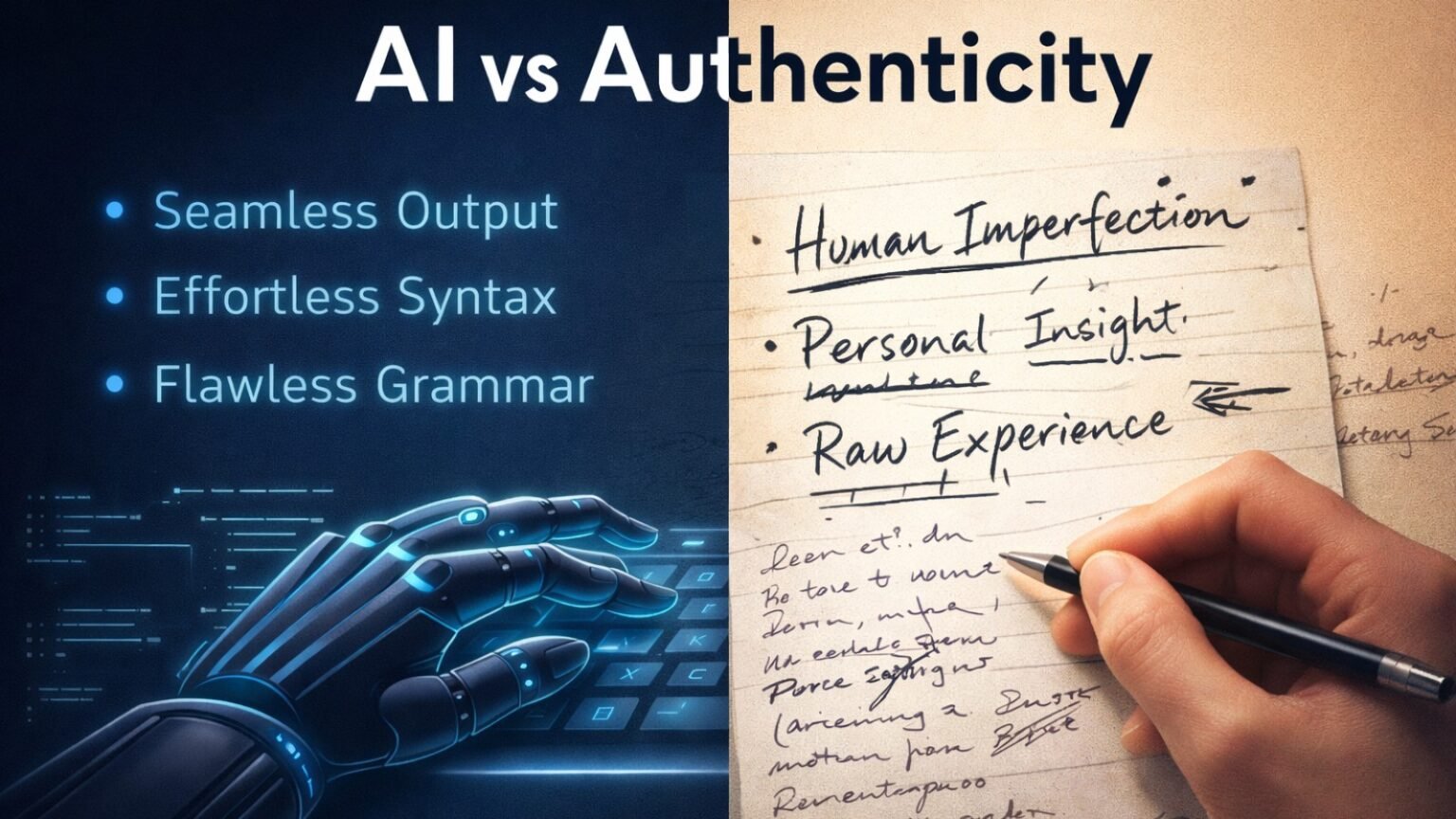

AI vs Authenticity is no longer a philosophical debate—it is becoming the defining cultural tension of the modern internet. As generative systems flood feeds with competent, frictionless content, the scarcity has shifted. It is no longer information that is rare. It is perspective.
AI vs Authenticity in the Age of Infinite Content
In 2024, the spectacle was capability. The public marveled at the fact that a machine could write a poem, draft a legal memo, or summarize a book. The novelty was technical achievement.
By 2026, novelty has evaporated.
The marginal cost of producing acceptable text is approaching zero. When production becomes infinite, attention becomes defensive. Audiences do not reward volume; they filter it.
This is the structural reason behind the shift from AI dominance to authenticity preference. The algorithm is not moral. It is economic. When synthetic content saturates supply, human specificity becomes the new differentiator.
The “Perfect” Voice Problem
We recognize machine text almost instantly. It is balanced, symmetrical, and polite. It uses the same transitional phrasing. It rarely risks contradiction.
Technically sound. Emotionally neutral.
The cultural issue is not that AI is inaccurate. It is that it is frictionless. And frictionless content does not signal cost. This tension sits at the heart of AI vs Authenticity in 2026.
In cultural economics, perceived effort often determines perceived value. A slightly messy paragraph written from lived experience carries more emotional weight than a perfectly structured but anonymous summary.
This is why short-form platforms are witnessing the rise of unscripted commentary. Viewers gravitate toward stumbles, imperfect edits, and opinionated framing. Imperfection signals humanity. Humanity signals cost. Cost signals value.
The “uncanny valley” of text is no longer a meme—it is a measurable engagement pattern.
The Paradox: Using AI to Strengthen the Human Signal
The AI vs Authenticity debate is frequently framed as a binary choice. Reject the machine, or surrender to it.
That framing is simplistic.
The most sophisticated creators are not discarding AI. They are repositioning it. Instead of delegating authorship, they are using AI as a cognitive amplifier—an outline assistant, a counterargument generator, a structural editor.
In this model, AI is not the voice. It is the scaffolding.
A founder drafting a memo may use a large language model to stress-test assumptions. A journalist may use it to summarize research before injecting original analysis. A strategist may use it to map arguments before writing in their own tone.
The distinction is subtle but critical. When AI produces the final artifact, authenticity erodes. When AI enhances thinking, authenticity sharpens.
This is the rise of the “cyborg creator”—not human versus machine, but human augmented by machine discipline.
Dead Internet Theory Meets Cultural Economics
The cultural anxiety surrounding AI content echoes earlier debates captured in the “Dead Internet Theory”—the fear that bots and automated systems would overwhelm genuine human interaction.
Whether literal or exaggerated, the concern points to a deeper structural shift: trust fragmentation.
As AI-generated material becomes indistinguishable from human output at scale, audiences will demand new verification layers. “Proof of Humanity” may emerge as a competitive advantage.
That proof will not necessarily require certification badges. It may manifest through:
- Personal anecdotes that resist templating
- Idiosyncratic phrasing that avoids generic symmetry
- Documented lived experience
- Transparent creative process
The premium will shift from polish to provenance.
For a structural breakdown of platform visibility economics, see our The Death of the Visibility KPI analysis.
The Prediction: “Proof of Humanity” as a Status Symbol
AI vs Authenticity will likely define brand positioning by the end of 2026. Just as “organic” labels once signaled health and quality in food markets, “human-written” may become a marketing differentiator in media and knowledge work.
This does not mean AI disappears. It means the visible human layer becomes strategically emphasized.
Typos become texture. Specificity becomes moat. Personal narrative becomes defensible IP.
Creators who optimize for sterile perfection risk blending into algorithmic noise. Creators who optimize for resonance—distinct tone, lived insight, and intellectual risk—signal authenticity.
The irony is clear: in a world of infinite intelligence, imperfection becomes luxury.
Why This Signals a Shift
AI vs Authenticity is not a rejection of technology. It is a recalibration of value. As generative systems democratize production, differentiation will rely on human context, perspective, and intellectual courage.
The question is no longer whether AI can create. It is whether creation still feels human.
For a strategic breakdown of AI writing tools, read our Best AI Writing Tools 2026 guide.
Why This Matters
Cultural shifts precede economic ones. When audiences begin to reward authenticity over automation, business models follow. Brands, media institutions, and independent creators who understand this transition early will not abandon AI—they will integrate it without erasing their signature.
In an AI-saturated internet, the rarest asset is no longer information. It is identity. That identity gap is precisely why AI vs Authenticity has become the defining narrative of digital culture.