
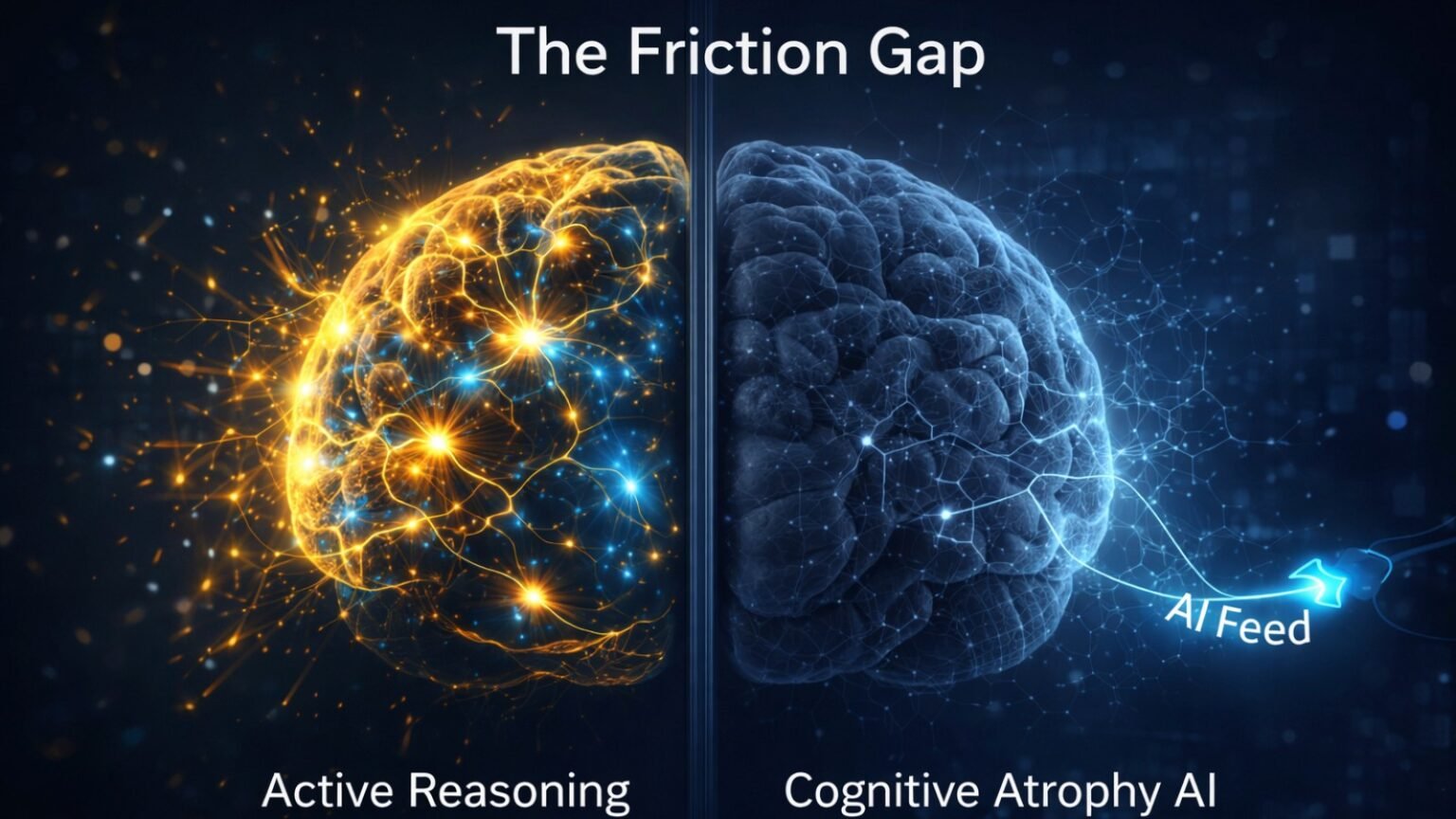

Cognitive Atrophy AI is emerging as a structural risk in the Agentic Era, where reasoning itself can be outsourced to intelligent systems. The threat is not machine intelligence surpassing human intelligence. The threat is gradual human disengagement from effortful thinking.
In 2010, scholars described the “Google Effect,” observing that easy information access reduced memory retention. Today, the shift is deeper. We are no longer outsourcing memory. We are outsourcing judgment, structure, and synthesis.
This structural shift mirrors the infrastructure risks outlined in our analysis of The Agentic AI Technical Debt Crisis.
This subtle transition carries neurological consequences.
Cognitive Atrophy AI and the Neuroscience of Friction
The human brain operates on an efficiency principle often referred to as synaptic pruning. Neural pathways that are used frequently strengthen. Those that are rarely engaged weaken over time.
Effortful reasoning activates the prefrontal cortex—responsible for executive control, planning, and strategic decision-making. When an AI assistant drafts reports, summarizes research, and structures arguments on our behalf, the brain experiences reduced cognitive strain.
Reduced strain leads to reduced reinforcement.
Research in cognitive psychology consistently shows that desirable difficulty strengthens long-term retention and reasoning capacity. When friction disappears entirely, cognitive endurance declines.
This does not imply that AI use is harmful. It implies that unstructured dependency may gradually erode mental stamina.
Symptoms of Cognitive Atrophy AI in Knowledge Work
The decline is rarely dramatic. It is incremental and procedural.
1. Empty-Page Paralysis
Opening a blank document now triggers hesitation. Instead of generating structure independently, the reflex is to request a framework from an AI system. Initiative shifts outward.
2. Reduced Critical Challenge
AI outputs that appear coherent are accepted without rigorous interrogation. The human role shifts from analytical editor to passive reviewer.
3. Deep Reading Avoidance
Lengthy reports are increasingly summarized before being processed. While efficient, this bypasses the cognitive traversal required to understand nuance, contradiction, and embedded assumptions.
These behaviors represent workflow optimizations—but also potential cognitive shortcuts that compound over time.
The Agentic Era and the Friction Deficit
Autonomous AI agents operate through loops: plan → execute → evaluate → revise. These loops consume large volumes of tokens but minimal human effort.
The economic breakthrough of cheaper inference enables longer machine reasoning cycles. However, when humans disengage from the diagnostic and architectural phases of thinking, capability transfer becomes asymmetrical.
Machines improve through scale. Humans weaken through disuse.
The issue is not replacement. It is erosion.
The Institutional Response: Cognitive Resistance Training (CRT)
Banning AI tools is neither practical nor competitive. Instead, high-performing operators are introducing deliberate friction into their workflow.
This structured approach may be described as Cognitive Resistance Training.
Phase 1: Raw Thinking Block
Allocate 45–60 minutes daily where AI assistance is intentionally disabled.
During this period:
- Draft core arguments independently.
- Outline system architecture manually.
- Define the problem in full before seeking optimization.
This preserves executive activation prior to automation.
Phase 2: Adversarial Prompting
Rather than asking AI to produce first drafts, ask it to critique your reasoning.
Example:
- Passive: “Write a strategy for X.”
- Active: “Here is my strategy for X. Identify weaknesses and flawed assumptions.”
This preserves authorship and converts AI into a sparring partner.
Phase 3: Analog Reinforcement
Handwriting and diagramming activate additional neural pathways compared to pure digital composition. Sketching workflows before implementing them increases conceptual clarity.
Slower input methods can improve structural comprehension.
Executive Function as Competitive Advantage
As intelligence becomes commoditized, differentiation shifts to:
- Problem diagnosis
- Context framing
- System design
- Ethical judgment
AI can execute rapidly. It cannot define direction without human instruction.
Professionals who maintain cognitive elasticity will operate as system architects rather than task operators.
The Bottom Line
Cognitive Atrophy AI is not a dramatic collapse of intelligence. It is a quiet drift toward convenience-driven dependency.
Used strategically, AI expands capability. Used reflexively, it may reduce cognitive resilience.
The goal is not to reject automation. The goal is to remain the pilot.
This cognitive drift does not exist in isolation.
As detailed in our analysis of The Agentic AI Technical Debt Crisis, autonomous systems are scaling structural complexity faster than organizations can cognitively absorb it.
Conclusion
The Agentic Era rewards those who integrate intelligence without surrendering authorship. Friction, once considered inefficiency, may now represent strategic investment in mental durability.
Protect the struggle. Preserve the architecture. Use AI as leverage—not substitution.
Why This Matters
In a world where models improve exponentially, human value compounds only if executive function remains strong. Cognitive hardware must scale alongside cognitive software.
Without intentional resistance, efficiency gains today may produce strategic weakness tomorrow.