

Perplexity vs Google Search 2026 is not a battle about which platform has more users — it is about how information is delivered, structured, and trusted in a post-link internet.
For more than two decades, Google defined search through ranking systems and link authority. In 2026, the rise of “answer engines” like Perplexity has introduced a new paradigm: synthesis over selection.
In 2026, the debate around Perplexity vs Google Search 2026 is no longer theoretical — it reflects a structural shift in how information is discovered and consumed.
Perplexity vs Google Search 2026: The Structural Difference
The difference between Perplexity and Google is not cosmetic. It is architectural.
Traditional search engines:
- Rank web pages.
- Optimize visibility through SEO.
- Monetize through ads layered above results.
Answer engines:
- Aggregate multiple sources.
- Synthesize responses.
- Provide citations inline.
- Allow conversational refinement.
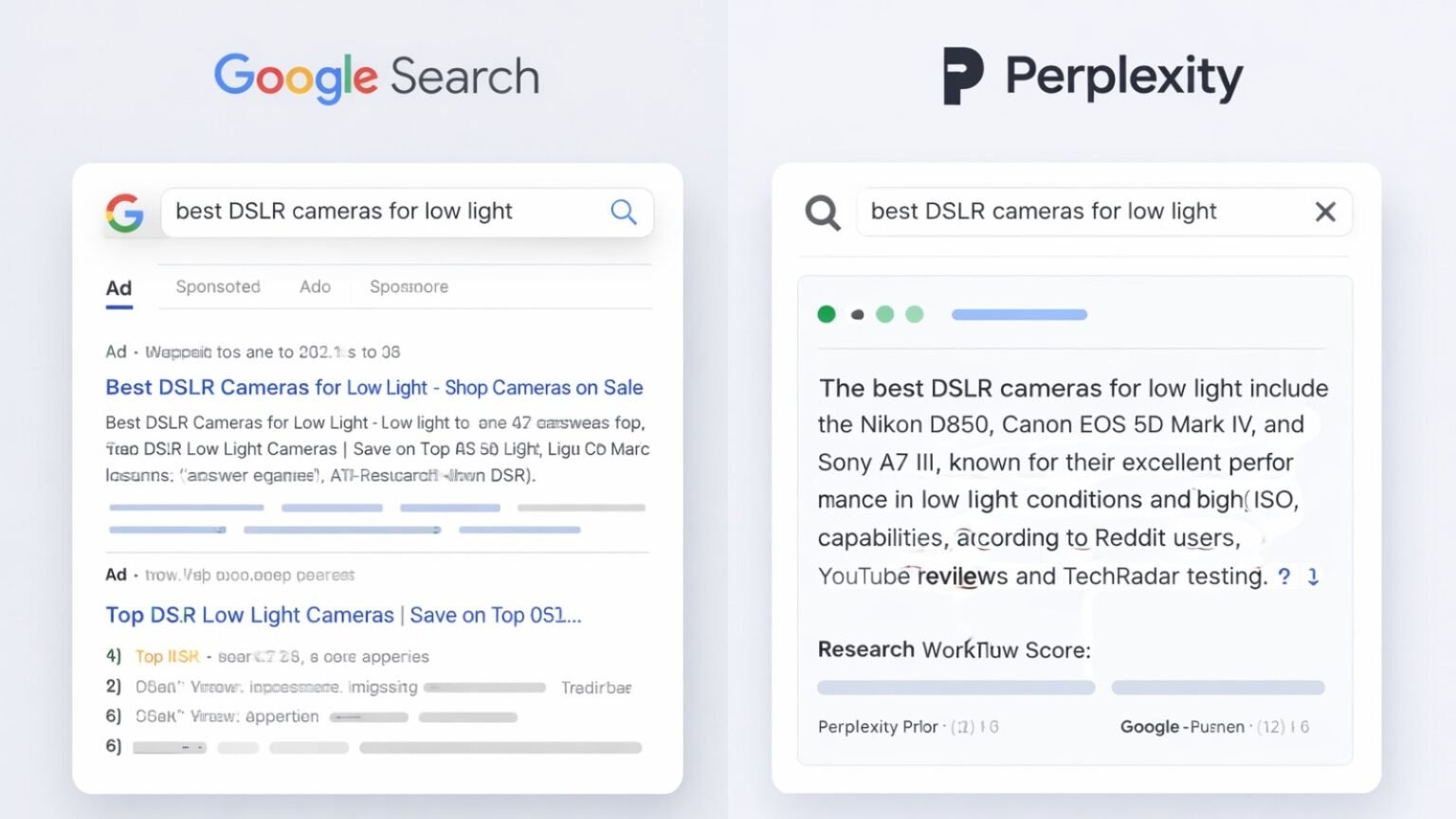
This shift compresses the research workflow. Instead of opening 8–12 tabs, users receive a summarized paragraph with references.
This is the same efficiency gain we observed when comparing large language models in our Claude Pro vs Gemini Advanced (2026) review.
Verdict: Who Wins in Perplexity vs Google Search 2026?
WINNER (Research Speed): Perplexity AI
Structured answers with citations reduce friction in research-heavy workflows.
WINNER (Local & Commercial Intent): Google Search
Maps, Shopping, Flights, and local search remain unmatched.
THE SHIFT:
Use Perplexity for knowledge synthesis.
Use Google for execution and transaction.
Research Workflow Score:
Perplexity Pro: 9.0 / 10
Google Search: 7.5 / 10
The Comparison: Search Engine vs Answer Engine
| Feature | Perplexity AI | Google Search |
|---|---|---|
| Output Format | Synthesized paragraph with citations | Ranked list of links |
| Ad Presence | Minimal sponsored questions | Ads often dominate top positions |
| Conversational Follow-Up | Native | Limited in classic interface |
| Research Depth | Strong summarization capability | Depends on user filtering |
| Local Services | Weak | Industry-leading |
| Commerce Integration | Limited | Deep ecosystem integration |
The table highlights the transition from “discovery browsing” to “intent answering.”
Buying Strategy: Who Should Use What?
If your workflow is knowledge-intensive — research, writing, analysis — Perplexity offers measurable efficiency gains.
If your workflow is action-oriented — purchasing, navigation, bookings — Google’s ecosystem retains dominance.
This duality suggests not replacement, but redistribution of intent.
The same logic applies to premium AI tools, as we explored in our Is ChatGPT Plus Worth It 2026? review.
Why Answer Engines Feel Faster
Perplexity reduces cognitive load.
Instead of:
- Reading multiple opinionated blog posts
- Filtering affiliate bias
- Comparing conflicting claims
Users receive:
- Consolidated summaries
- Cited sources
- Immediate refinement through follow-up prompts
However, answer engines are only as strong as their source base. Citations must still be verified. Synthesis does not eliminate responsibility.
However, answer engines are only as strong as their source base. Citations must still be verified. As a recent Stanford HAI study found that leading AI models hallucinate in 1 out of 6 (or more) legal benchmarking queries, synthesis does not eliminate responsibility.
Strategic Implications for Creators and Institutions
The Perplexity vs Google Search 2026 debate carries larger implications:
- SEO as a Traffic Strategy Is Fragmenting
If answers are extracted before users click, website traffic models shift. - Authority Moves From Ranking to Referencing
Being cited inside answer engines may matter more than ranking position. - Ads Lose Prime Real Estate
If research intent shifts to summarized answers, ad density becomes less effective for informational queries. - Knowledge Work Accelerates
Students, analysts, and researchers gain speed advantages through structured synthesis.
This does not signal the death of search — but it signals the end of passive browsing as default behavior.
The Bigger Picture
Ultimately, Perplexity vs Google Search 2026 is not about replacement — it is about redistribution of user intent.
Google built the discovery economy.
Answer engines are building the synthesis economy.
The difference is subtle but foundational:
Search engines reward visibility.
Answer engines reward structured truth.
In 2026, the smartest digital workflow is hybrid:
Research with answer engines.
Act with search engines.
The question is no longer “Is Googling dead?”
The real question is:
Are we moving from searching for information
to demanding clarity?
That shift defines the future of digital intelligence.