

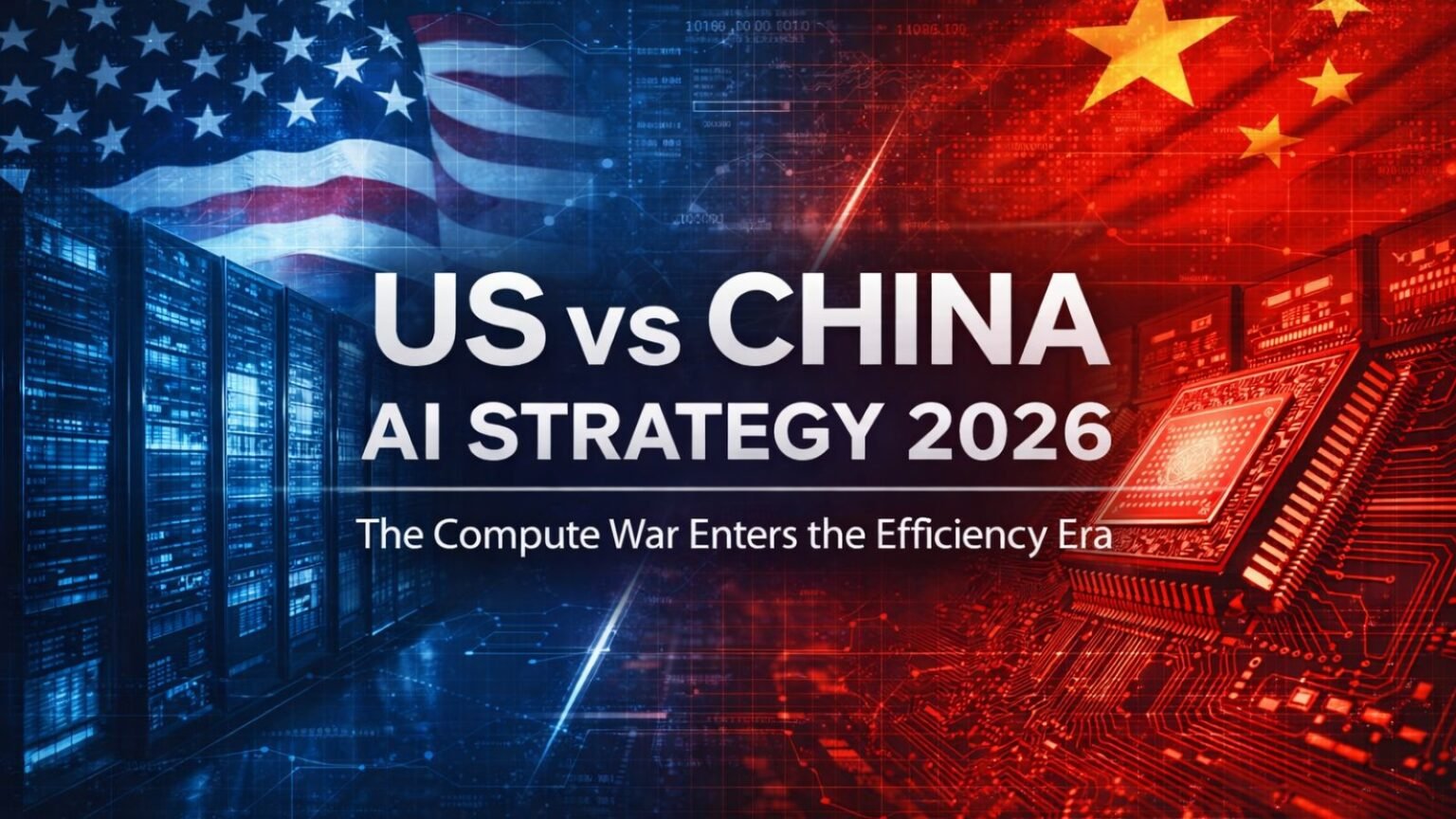

The US vs China AI Strategy 2026 represents a structural turning point in the global technology race. What began as a competition over who owns the most advanced chips has evolved into a battle over who can generate intelligence more efficiently.
US vs China AI Strategy 2026: From Chip Dominance to Algorithmic Efficiency
For the past three years, Washington operated on a simple premise: control high-end semiconductor exports, and you control the pace of Chinese AI development.
The restrictions on advanced NVIDIA GPUs were designed to freeze Beijing’s progress at a 2024 baseline. Instead, they forced adaptation.
Chinese labs such as DeepSeek responded by optimizing architectures for lower compute consumption. Rather than competing on raw scaling laws alone, they prioritized efficiency-per-parameter and cost-per-token metrics.
The shift matters because compute is capital intensive. Large frontier models in the U.S. rely on billion-dollar data centers and energy-heavy infrastructure. If comparable performance can be achieved using a fraction of that cost, the barrier to entry shifts dramatically.
As explored in our DeepSeek cost analysis
The efficiency delta is not merely technical. It alters capital allocation, cloud pricing models, and startup formation dynamics worldwide.
The Doctrinal Divide: Scaling vs Precision
The United States AI doctrine has historically leaned into scaling laws:
- More GPUs
- Larger training datasets
- Greater parameter counts
- Centralized infrastructure
This model works — but it is expensive and energy-intensive.
China’s constrained environment accelerated a different doctrine:
- Compression techniques
- Smarter architectural tuning
- Cost-optimized deployment
- Distributed accessibility
If “good enough” intelligence can run on smaller hardware footprints, the strategic advantage shifts from whoever builds the largest cluster to whoever democratizes access fastest.
This is where the US vs China AI Strategy 2026 becomes geopolitical.
If emerging markets adopt efficiency-first models due to affordability, global AI alignment patterns may change.
Open Source as Strategic Leverage
Another divergence lies in distribution philosophy.
Several Chinese labs have released model weights publicly, accelerating developer experimentation. In contrast, U.S. frontier systems remain API-gated and commercially controlled.
Open access can:
- Increase global developer adoption
- Lower experimentation costs
- Accelerate derivative innovation
The risk for the U.S. ecosystem is structural dependency on closed models, while open ecosystems spread influence through accessibility.
For official U.S. semiconductor export policy details, see the U.S. Department of Commerce overview.
Strategic Implications: Sovereignty, Infrastructure, and Fragmentation
The US vs China AI Strategy 2026 is not about chatbots. It is about economic sovereignty.
Artificial intelligence increasingly functions as infrastructure:
- Financial modeling
- Defense simulations
- Logistics optimization
- Media generation
- Research acceleration
If compute efficiency lowers deployment cost globally, the competitive map of AI power diffuses.
Three potential scenarios emerge:
Short Term (0–6 Months):
Efficiency-focused local models increase viability of on-device AI.
Medium Term (6–18 Months):
Cloud providers may adjust pricing structures to compete against lower-cost alternatives.
Long Term:
Digital ecosystems fragment into regulatory and infrastructural blocs:
- Western AI compliance regimes
- Eastern AI deployment standards
This fragmentation risks incompatible governance norms and divergent information architectures.
Conclusion
The US vs China AI Strategy 2026 marks a pivot from brute-force scaling to strategic efficiency. Compute power still matters, but cost-per-intelligence now shapes competitive advantage.
Nations no longer win by hoarding hardware alone. They win by reducing the marginal cost of intelligence.
Why This Matters
Technological races are rarely decided by headlines. They are decided by cost curves.
If intelligence becomes cheaper to generate, it becomes harder to contain. And if it becomes harder to contain, it reshapes economic leverage, defense strategy, and digital sovereignty.
The tipping point in 2026 is not symbolic. It is structural.
The global AI order may soon be defined less by who builds the biggest models — and more by who builds the most efficient ones.