
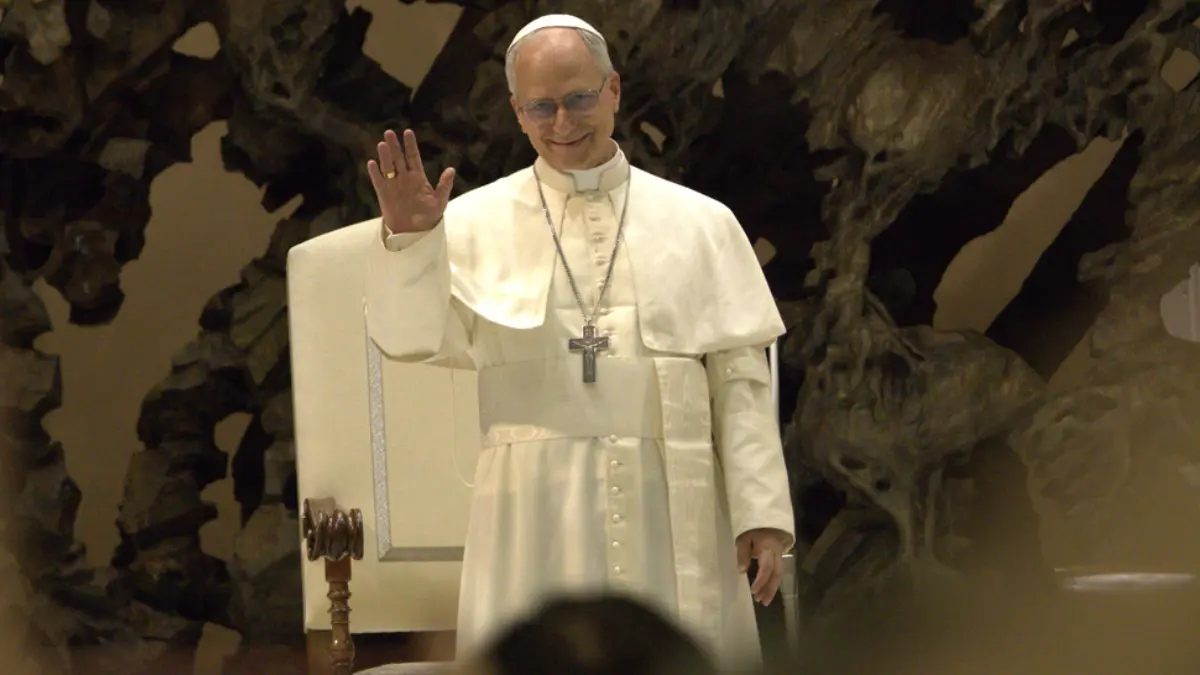

Pope Leo XIV stepped onto his plane bound for Algeria on Monday and said something that no American religious leader has said in recent memory: that he has no fear of the sitting president of the United States. He would continue to speak out against war, promote peace, and encourage dialogue between nations. And he did not want to get into a debate.
The context matters as much as the words. Trump had spent the previous 24 hours attacking the first American pope on Truth Social, calling him “WEAK on Crime, and terrible for Foreign Policy,” claiming the Vatican chose Leo specifically to “deal with” him, and posting — then quietly deleting — an AI-generated image of himself in biblical robes healing the sick. The exchange has the texture of a personal feud. Its structure is something considerably more serious.
The Collision That Was Building
This confrontation did not begin over a single weekend. It has been accumulating since Leo’s election, accelerating through Holy Week, and arriving at full rupture on Easter Sunday — when Trump posted a profanity-laced demand that Iran reopen the Strait of Hormuz, while Leo used his Easter Mass to call on those “who have weapons” to “lay them down.”
When Trump subsequently threatened that “a whole civilization will die tonight,” Leo called the rhetoric “truly unacceptable.” That assessment — from the leader of 1.4 billion Catholics worldwide — placed the institutional weight of the Church directly against an active US military operation. The question of whether a pope can take that position, and what follows when he does, is now live in a way it has not been for decades.
Pope Leo and the American Catholic Vote
Trump’s approval among white Catholics — a constituency that delivered critical electoral margins in both of his presidential victories — fell from 59% in February 2025 to 52% in January 2026, according to Pew Research data. That is a 7-point decline over 12 months, occurring before this weekend’s escalation.
American Catholics are not a monolithic political bloc, but they are a persuadable one. The US Conference of Catholic Bishops — not a body historically inclined toward direct criticism of Republican presidents — said it was “disheartened” by Trump’s remarks. Archbishop Paul S. Coakley was precise: “Pope Leo is not his rival; nor is the Pope a politician.”
That last phrase is the institutional tell. The bishops are not defending Leo’s specific positions on the Iran war. They are defending the category of moral authority itself — the principle that a religious institution has standing to speak on questions of war and peace without being subordinated to the executive. That distinction matters for the long-term health of the Church’s political relationships regardless of which party holds the White House.
The governance dimensions of how institutions manage moral boundaries have rarely been tested as publicly as they are right now — and earlier this month, the Kanye West entry ban illustrated how those boundaries hold very differently depending on whether the institution or the state initiates the action.
Who Benefits, Who Is Exposed
In the short term, Trump’s base will read this as exactly the confrontation it prefers: a president refusing to be lectured by a liberal institution. That reading is coherent within its own political logic. The structural problem is that the Catholic swing voters who delivered margins in Wisconsin, Pennsylvania, and Michigan are a different audience — and one already in motion away from Trump before this week.
Pope Leo’s positioning is also more complicated than it appears. His authority derives partly from being perceived as above national political contests. The moment he is successfully framed as a factional domestic actor — even if that framing is entirely Trump’s construction — his institutional leverage diminishes. He is navigating this deliberately: declining to debate, speaking from Gospel language rather than geopolitical language, and departing immediately for four African countries, signalling a global rather than American-centric relevance.
According to CNN’s reporting on the Trump-Leo confrontation, Catholic observers noted that Trump’s comments were a sign he was “feeling threatened that Leo was emerging as a stronger figure on the international scene” — a read that, if accurate, suggests the confrontation has already shifted institutional momentum in a direction Trump did not intend.
What the Bishops’ Response Actually Signals
Religious institutions in liberal democracies derive authority partly from being perceived as operating outside partisan politics. When an executive publicly frames a pope as a political opponent, the institution faces a structural choice: absorb the attack and appear weak, or respond and risk appearing partisan.
The US bishops chose a third path. “Pope Leo is not his rival” is a statement about institutional roles, not about Iran policy. It is designed to preserve the Church’s standing as a moral actor without converting that standing into a political endorsement. Whether that manoeuvre holds depends largely on whether Trump continues pressing the confrontation — and on whether Leo’s Africa tour succeeds in repositioning him visually as a global figure rather than a domestic American one.
The structural erosion of institutional counterweights in European democracies — most recently visible in Hungary — has shown what happens when the boundary between state power and moral authority collapses over time. The US is not Hungary. But the stress test now underway is a version of the same foundational question.
What Changes Next
Leo’s 11-day, four-country Africa tour is not coincidental timing. It is a deliberate institutional repositioning — demonstrating that the Vatican’s reach extends well beyond the US-European axis that Trump’s framing assumes. A pope who is globally legible as a moral counterweight to American executive power becomes more consequential in international conversations about war, refugees, and governance. Not less.
For Trump, the political terrain is narrowing. A sustained public feud with the first American pope — fought on moral and religious ground where presidential authority carries less weight than in domestic policy — is not obviously advantageous with the Catholic constituencies he still needs. The 7-point approval decline among white Catholics predates this weekend. The trajectory after it will be the number to watch.
Conclusion
Two Americans — one with temporal power, one with institutional moral authority — are now openly contesting the terms of their relationship. Neither side appears ready to concede ground. The Church is watching. So are 52 million American Catholics.
Why This Matters (The Bigger Picture)
What is happening here is not a personality clash that happens to involve two famous Americans. It is a stress test of one of liberal democracy’s oldest arrangements: the negotiated boundary between state power and moral authority. In most functioning democracies, that boundary holds not because it is legally enforceable, but because both sides understand its value to their own legitimacy.
Trump’s public attack has broken that convention openly. Whether or not it costs him Catholic votes in the short term, it has done something structural: it has made the Vatican an active participant in American domestic political discourse in a way it has not been for decades. Pope Leo, for his part, has accepted that role — not by entering the political debate, but by refusing to leave the moral one.